

Supplement CRO: The 4-Pillar Testing Framework for Shopify Supplement Brands
Most supplement brands do not have a traffic problem. They have a conversion clarity problem. The category is crowded, customer acquisition is expensive, and shoppers are increasingly skeptical. A visitor landing on a supplement product page is rarely asking only, “Do I want this?”
They are asking:
- Can I trust what is in this bottle?
- Why is this different from every other supplement I’ve seen?
- How does this fit into my routine?
- Should I subscribe, buy once, or leave and compare labels somewhere else?
That is what makes supplement CRO different.
In apparel, CRO may focus heavily on sizing, merchandising, imagery, and checkout friction. In supplements, the conversion path is more complex. A strong product page has to educate, reassure, differentiate, and sell the routine behind the product.
Absolute Web partnered with Shoplift and Recharge on The Supplement CRO Playbook, a category-specific framework featuring 100 test ideas across four pillars: trust, differentiation, routine and kit building, and subscriptions.
This article breaks down the most important takeaways and how supplement brands can apply them.
For the complete test bank and roadmap template, you can also download the full Supplement CRO Playbook from Shoplift.
Watch the Full CRO Masterclass
For a deeper discussion of the framework, testing ideas, subscription mechanics, and growth opportunities covered by Absolute Web, Shoplift, and Recharge, watch the full masterclass below.
Why Supplement CRO Requires Its Own Playbook
Generic CRO advice often misses what makes supplement ecommerce unique.
Many best-practice CRO frameworks push brands to simplify product pages, reduce copy, and remove friction. But supplement shoppers often need more information, not less. They want proof, context, dosage clarity, ingredient transparency, third-party validation, and confidence that the product fits their specific goal. The real CRO challenge is not removing information. It is sequencing the right information at the right moment.
In the Supplement CRO Playbook, four dynamics shape nearly every optimization opportunity:
- Trust signals are category-specific.
Certifications, supplement facts, testing standards, GMP manufacturing, COAs, and ingredient transparency carry more weight here than in most ecommerce categories. - Differentiation is harder.
Many products look similar: protein tubs, vitamin bottles, greens powders, capsules, gummies. Brands need stronger visual identity, audience-specific positioning, and human storytelling to stand out. - First-order economics depend on the stack.
A one-product first order may not be enough to make acquisition efficient. Multi-product routines, bundles, and kits can change the economics of the first purchase. - Subscriptions are central to the business model.
Supplements are replenishable by nature. The question is not simply whether to offer subscriptions, but how to present, price, time, and retain them.
The best brands do not optimize one of these areas in isolation.
They test all four together.
The Two Numbers That Decide Whether a Supplement Brand Scales
At a strategic level, supplement CRO comes down to two conversion gates:
First-order conversion rate: What percentage of cold traffic buys?
Subscription conversion rate: What percentage of those buyers attach to a subscription?
Move both, and the business changes.
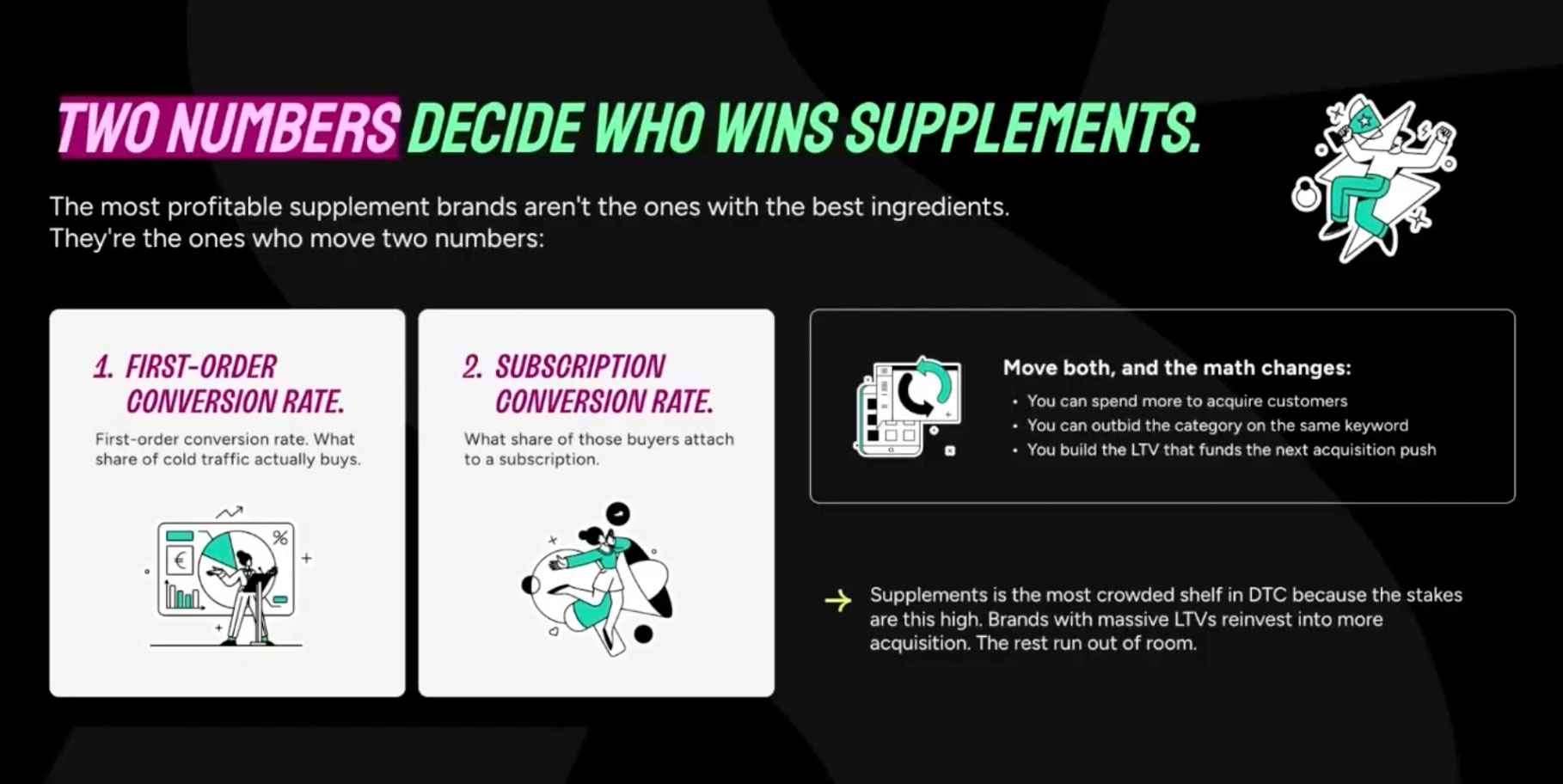
A higher first-order conversion rate makes paid acquisition more efficient. A higher subscription attach rate increases customer lifetime value. When those two numbers improve together, brands can spend more confidently to acquire customers because the economics have more room to work.
This is why supplement CRO should not be treated as a cosmetic website improvement project.
It is a growth model problem.
Every test should answer one question:
Does this improve first-order conversion, subscription attach, AOV, retention, or revenue per visitor?
If the answer is unclear, the test probably is not ready.
Pillar 1: Trust Signals and Claims
Trust is the first conversion gate in supplements.
Before shoppers care about your subscription discount or bundle offer, they need to believe the product is credible. That means your product page has to answer the question every first-time supplement shopper asks:
“Can I trust what is in this bottle?”
Many brands already have the trust assets they need. They simply display them inconsistently.
Common examples include:
- Certification badges shown on the homepage but missing from PDPs
- Supplement facts panels buried below long-form copy
- COAs hidden on a testing page
- GMP claims placed too low on the page
- Clinical references mentioned vaguely
- Ingredient sourcing details omitted from the buying journey
- Trust badges visible on desktop but buried on mobile
The opportunity is to bring trust closer to the add-to-cart decision.
What Supplement Brands Should Test
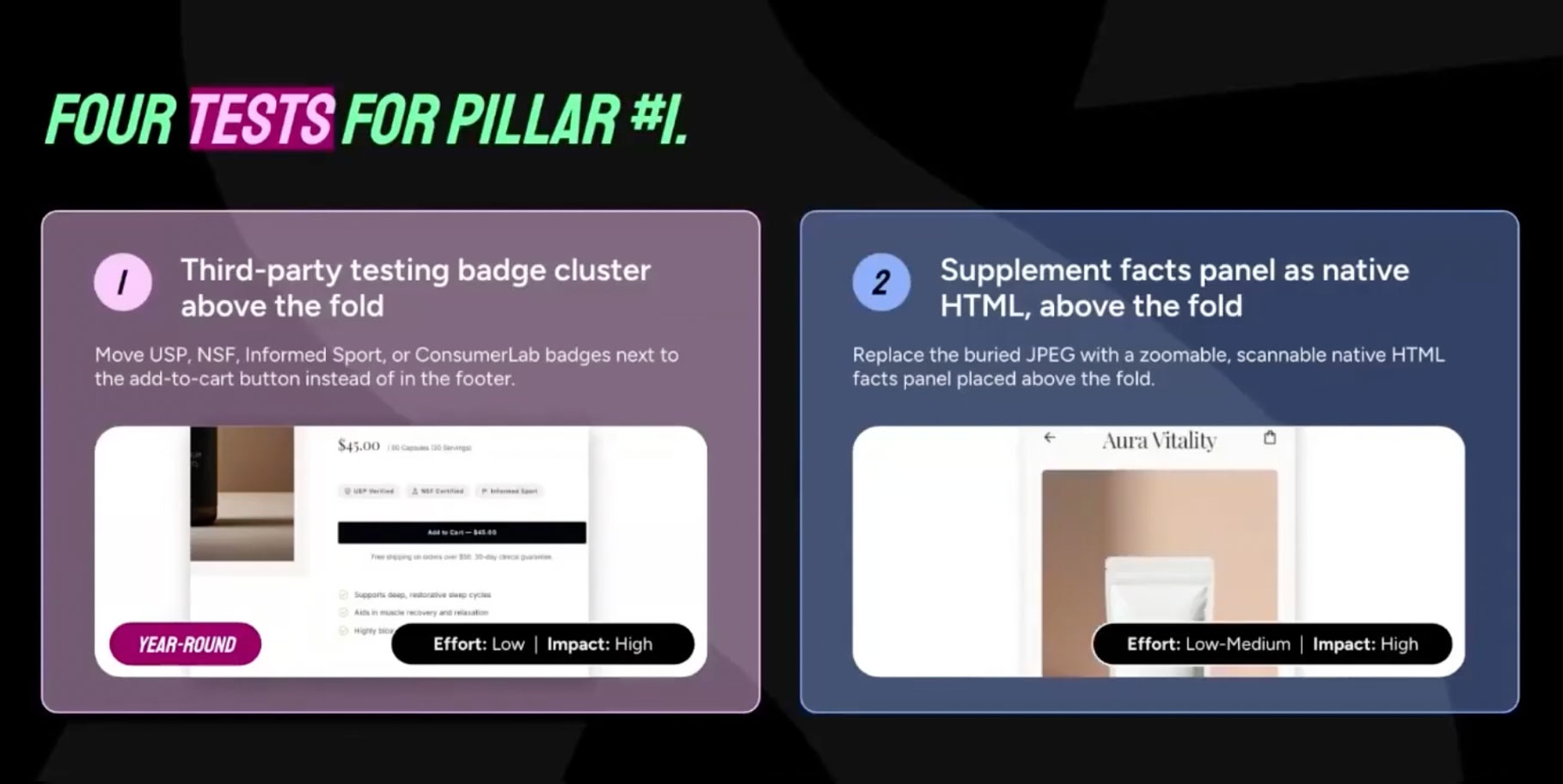
1. Third-Party Badge Cluster
Certifications such as NSF, USP, Informed Sport, ConsumerLab, GMP, USDA Organic, and Non-GMO Project Verified should be tested near the add-to-cart button.
Why it matters: Trust signals work best when they appear at the moment of hesitation.
2. Supplement Facts Panel Placement
The supplement facts panel should not be treated as a legal formality. For many shoppers, it is one of the most important product-page elements.
Test placing it higher on the PDP, especially on mobile. Use native HTML where possible instead of a hard-to-read image.
Why it matters: If shoppers have to hunt for basic formulation information, confidence drops.
3. Badge Hierarchy
Not every badge carries the same weight for every audience.
For a sports nutrition brand, NSF Certified for Sport or Informed Sport may matter most. For clinical or longevity products, USP, ConsumerLab, COAs, or study references may carry more weight.
Why it matters: The first badge shoppers see often shapes the credibility of the entire page.
4. Claim Language
Supplement brands need to balance persuasive copy with compliance. Test different claim hierarchies:
- Outcome-led: “Feel sharper by 2pm”
- Ingredient-led: “400mg Magnesium Glycinate”
- Credential-led: “Formulated by Dr. X”
- Mechanism-led: “Designed to support your evening wind-down routine”
Why it matters: Different traffic sources respond to different proof structures. Paid social may respond to outcomes. Organic visitors may respond to ingredients. Premium buyers may respond to credentials.
5. COA or Lab Result Access
For premium, clinical, sports performance, prenatal, and longevity brands, batch-level testing can be a powerful differentiator.
Why it matters: Science-literate shoppers want proof they can verify.
Pillar 2: Brand Differentiation
Most supplement brands say the same things.
“Clinically dosed.”
“Science-backed.”
“Premium ingredients.”
“Third-party tested.”
“Clean formula.”
Those statements may be necessary, but they are rarely enough to differentiate.
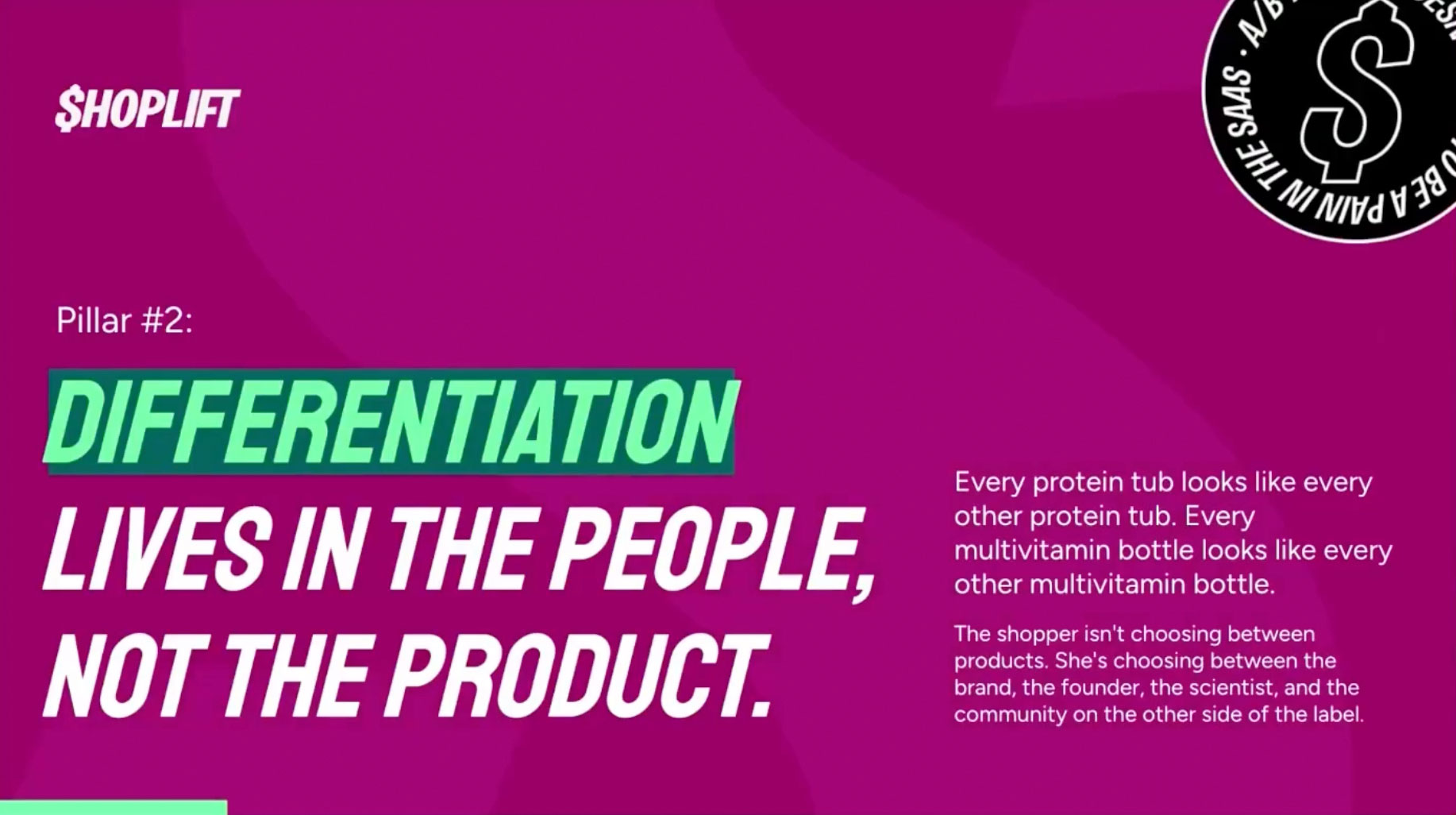
In supplements, differentiation often comes less from the product itself and more from the context around it.
Who made it?
Who is it for?
Why was it formulated this way?
What routine does it belong to?
What problem does it solve better than the alternatives?
The brands that win make the answer obvious.
Differentiation Comes From People, Not Just Products
A bottle is easy to copy.
A founder story is not.
A formulator’s rationale is not.
An athlete community is not.
A doctor’s point of view is not.
A customer movement is not.
That is why founder, formulator, athlete, doctor, coach, and community modules can outperform generic brand copy.
Instead of hiding these assets on the About page, test bringing them onto the PDP where the purchase decision happens.
What Supplement Brands Should Test
1. Founder or Formulator Module
Add a short section explaining who made the product and why.
This works especially well for:
- Longevity brands
- Women’s health brands
- Clinical formulations
- Premium supplements
- Founder-led challenger brands
Why it matters: People create trust faster than anonymous claims.
2. Cost-Per-Serving Framing
Premium supplements often lose customers at the bottle price.
A $49 product may feel expensive. A $1.63 daily serving may feel reasonable.
Why it matters: Cost-per-serving reframes price around daily value.
3. “Why We Made This” Rationale
Explain the specific market gap or formulation decision behind the product.
Weak version: “We wanted to make a better supplement.”
Stronger version: “Most magnesium products use cheaper forms that are harder to tolerate, so we built ours around magnesium glycinate and designed the dose for nightly use.”
Why it matters: Shoppers need to understand why the product deserves attention.
4. Lifestyle Hero vs. Product-Only Hero
A product-only image may show the bottle clearly, but it does not always answer “is this for me?”
Lifestyle and in-context visuals can communicate the customer identity and use occasion faster.
Examples:
- Protein in a shaker after training
- Magnesium on a nightstand
- Greens being mixed into a morning routine
- Prenatal vitamins beside a daily wellness setup
- Electrolytes in a gym bag or travel context
Why it matters: Supplement products are often visually similar. Context creates differentiation.
5. Format Clarity
Show pill size, scoop size, gummy texture, powder mixability, or serving quantity clearly.
Why it matters: Format disappointment leads to returns, cancellations, and poor reviews.
Pillar 3: Routine and Kit Building
Many supplement brands merchandise products as individual SKUs.
Customers do not think that way.
They think in goals:
- Sleep better
- Build muscle
- Improve gut health
- Support immunity
- Increase energy
- Recover faster
- Support healthy aging
- Stay consistent
- Improve daily wellness
That is why stack building is one of the most underbuilt conversion mechanics in supplement ecommerce.
A product solves a task.
A stack solves a goal.
A routine builds retention.
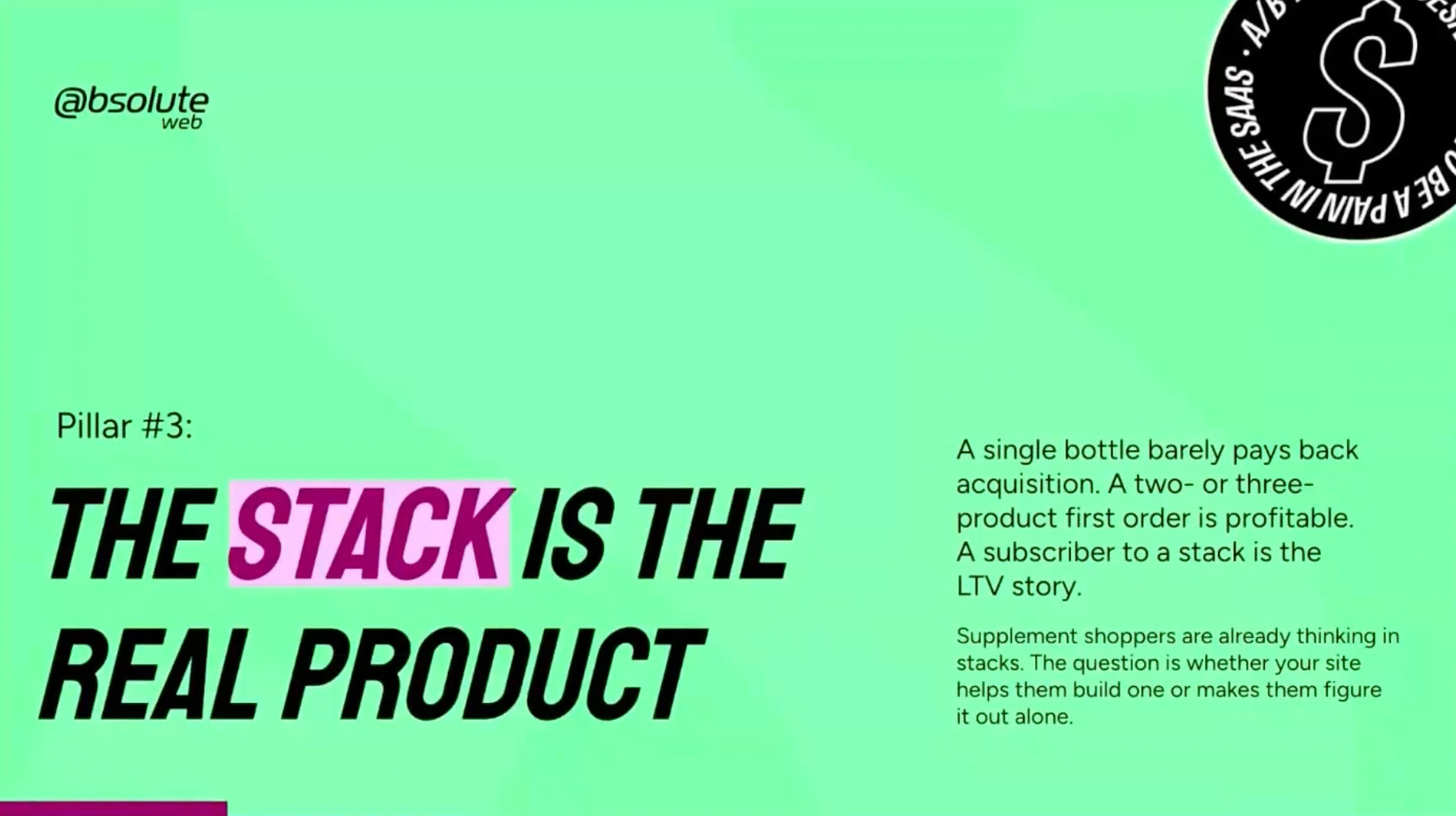
Why Stacks Matter
A first-time shopper buying one product may barely make the acquisition economics work. A shopper buying two or three complementary products creates a very different order profile.
Stack building can improve:
- Average order value
- First-order profitability
- Subscription potential
- Customer education
- Retention
- Second-order behavior
But the stack has to feel curated, not algorithmic.
Generic “frequently bought together” widgets often underperform because they do not explain why the products belong together.
A stronger approach names the system.
Examples:
- The Foundational Stack
- The Sleep Protocol
- The Performance Stack
- The Gut Health Routine
- The Immunity Kit
- The Longevity Stack
- The AM/PM Routine
- The Recovery System
The name does part of the conversion work.
What Supplement Brands Should Test
1. “Complete Your Stack” on the PDP
Replace generic cross-sells with curated recommendations tied to the shopper’s goal.
Example: A multivitamin PDP recommends omega-3 and vitamin D as part of “The Foundational Stack.”
Why it matters: It turns cross-sell into education.
2. Named Stack Collections
Create landing pages or collection modules around outcome-based stacks.
Why it matters: Customers are more likely to buy multiple products when the relationship between them is clear.
3. Goal-Based Navigation
Organize navigation around customer goals instead of only product types.
Examples:
- Sleep
- Energy
- Immunity
- Gut Health
- Recovery
- Focus
- Longevity
Why it matters: Shoppers enter the site with goals, not SKU names.
4. Dynamic Cart Bundles
If a customer adds one product, suggest the logical complement in the cart.
Example: Adding protein triggers a creatine or recovery recommendation. Adding a probiotic triggers a prebiotic or fiber recommendation.
Why it matters: The cart is a high-intent moment. Relevant offers can lift AOV without disrupting conversion.
5. Post-Purchase Stack Expansion
After checkout, recommend the missing piece of the routine.
Why it matters: The post-purchase moment can increase second-order value without adding friction to the initial purchase.
Pillar 4: Subscriptions
In many ecommerce categories, subscription is a retention feature.
In supplements, subscription is often the business model.
The product runs out. The customer expects replenishment. The brand has a natural opportunity to turn a one-time order into a recurring relationship.
But subscription performance is not determined by a single “subscribe and save” toggle.
It is shaped by many testable decisions:
- Is subscription selected by default?
- Where does the toggle appear?
- Is the discount shown as a percentage or dollar amount?
- What frequency is preselected?
- Is “cancel anytime” visible?
- Is free shipping tied to subscription?
- Are subscriber perks explained?
- Is subscription repeated in the cart?
- Is the cadence aligned to actual consumption?
- Does the brand offer pause or skip before cancellation?
- Are replenishment reminders timed before the product runs out?
Subscription CRO starts on the PDP, not after the purchase.
What Supplement Brands Should Test
1. Default-to-Subscribe Selection
For daily-use SKUs, test defaulting the product page to subscription rather than one-time purchase.
Why it matters: Many supplement products are naturally replenishable. The default can shape buyer behavior.
Watch-out: Measure first-renewal retention, not just attach rate. A higher attach rate is not valuable if customers cancel before the second shipment.
2. Discount Level
Test 10%, 15%, and 20% where margins allow.
Higher discounts may increase attach, but they can also attract deal-seekers who cancel quickly.
Why it matters: The best discount is not the one that maximizes first-order attach. It is the one that maximizes long-term LTV and margin.
3. Frequency Defaults
A 30-day default may not fit every product.
Protein, vitamins, greens, magnesium, probiotics, and electrolytes all have different consumption patterns.
Why it matters: Poor cadence creates “I have too much” cancellations.
4. Dollar vs. Percentage Framing
Test “Save 15%” against “$29 monthly vs. $39 one-time.”
Why it matters: Dollar framing can be easier for shoppers to understand, especially on premium SKUs.
5. Pause or Skip Before Cancel
When customers cancel because they have too much product, the issue may be timing, not dissatisfaction.
Offer skip, pause, or frequency adjustment before cancellation.
Why it matters: Retention improves when customers feel in control.
The Metrics That Matter Most in Supplement CRO
Conversion rate is important, but it is not enough. A test can increase conversion rate while lowering AOV, reducing subscription attach, or attracting low-quality customers who churn after the first shipment. Supplement brands need a broader measurement model.
1. Revenue Per Visitor
Revenue per visitor combines conversion rate and AOV. This should be the north star for most CRO tests. A test that slightly lowers conversion but significantly increases AOV may still be a better business outcome.
2. Subscription Attach Rate
This measures the percentage of eligible purchases that include a subscription. A lift in attach rate can materially change acquisition economics, especially for daily-use products.
3. First-Renewal Retention
The second shipment is one of the most important moments in subscription supplements. If a customer does not renew after the first order, the subscription was not truly retained.
4. Stack Rate
Stack rate measures the percentage of first orders with two or more SKUs. This is critical for brands trying to improve AOV and first-order profitability.
5. Replenishment Recapture Rate
This measures how many non-subscribers return for a second purchase within the expected replenishment window. Many brands undertrack this metric.
6. Return Rate
Returns can reveal when claims, imagery, dosage expectations, flavor promises, or product format expectations are misaligned. A conversion lift that increases returns may not be a real win.
7. Segmented Performance
Always segment by:
- New vs. returning visitors
- Mobile vs. desktop
- Paid vs. organic traffic
- Quiz completers vs. browsers
- One-time buyers vs. subscribers
- First-time buyers vs. repeat customers
Aggregate results can hide the real signal.
A 60–90 Day Supplement CRO Roadmap
For brands that are not yet running a structured testing program, start with five foundational tests. These are low-effort, high-impact, and relevant to most supplement brands.
Test 1: Move the Supplement Facts Panel Higher
Make it easier for shoppers to verify the formula.
Primary metric: Add-to-cart rate
Secondary metrics: PDP conversion rate, mobile engagement, return rate
Test 2: Add a Trust Badge Cluster Near the CTA
Show your strongest trust signals at the decision point.
Primary metric: PDP conversion rate
Secondary metrics: New visitor conversion, mobile conversion, RPV
Test 3: Test Subscribe-and-Save Default Selection
For daily-use products, test whether subscription should be preselected.
Primary metric: Subscription attach rate
Secondary metrics: Overall conversion rate, first-renewal retention, cancellation reason
Test 4: Replace Generic Cross-Sells With “Complete Your Stack”
Recommend complementary products tied to the customer’s goal.
Primary metric: AOV
Secondary metrics: Stack rate, RPV, cart conversion
Test 5: Add Cost-Per-Serving Framing
Translate bottle price into daily value.
Primary metric: PDP conversion rate
Secondary metrics: RPV, subscription attach, premium SKU conversion
Run these over 60–90 days, document the learnings, then use the results to build a longer-term roadmap. If you’d like a second set of eyes on your testing strategy, reach out to Absolute Web for a CRO assessment and roadmap tailored to your brand.
How to Prioritize Tests by Supplement Category
Supplements are not monolithic. The best CRO roadmap depends on the product type, audience, price point, catalog depth, and subscription behavior.
Vitamins and Daily Wellness
Best first tests:
- Subscribe-and-save default
- Cost-per-serving framing
- Supplement facts panel placement
- Foundational stack cross-sell
- 30/45/60-day replenishment cadence
Why it matters: Daily-use SKUs often have strong subscription potential because the consumption cycle is predictable.
Sports Nutrition and Performance
Best first tests:
- NSF Certified for Sport or Informed Sport badge placement
- Mixability imagery or video
- Performance stack builder
- Athlete or coach endorsement
- Sample pack at checkout for flavors
Why it matters: Performance shoppers are often research-heavy and highly sensitive to proof, taste, texture, and banned-substance testing.
Longevity and Anti-Aging
Best first tests:
- Clinical reference formatting
- Bioavailability explanation
- Founder, scientist, or formulator prominence
- Annual subscription presentation
- Mechanism-of-action explainer
Why it matters: Longevity shoppers may tolerate higher price points, but they expect stronger proof and clearer rationale.
Gut Health and Probiotics
Best first tests:
- Strain-specific benefit callouts
- Gut health quiz
- Probiotic + prebiotic + fiber bundle
- Shelf-stability and CFU-at-expiration proof
- Formulator explanation
Why it matters: Gut health shoppers often need education, but too much complexity can slow conversion.
Life-Stage and Outcome-Led Brands
Best first tests:
- Life-stage quiz
- Specialist credential hierarchy
- Stage-based bundles
- Safety-focused trust signals
- Outcome-led PDP copy
Why it matters: These shoppers often self-segment. A fertility shopper, postpartum shopper, and perimenopause shopper should not receive the same journey.
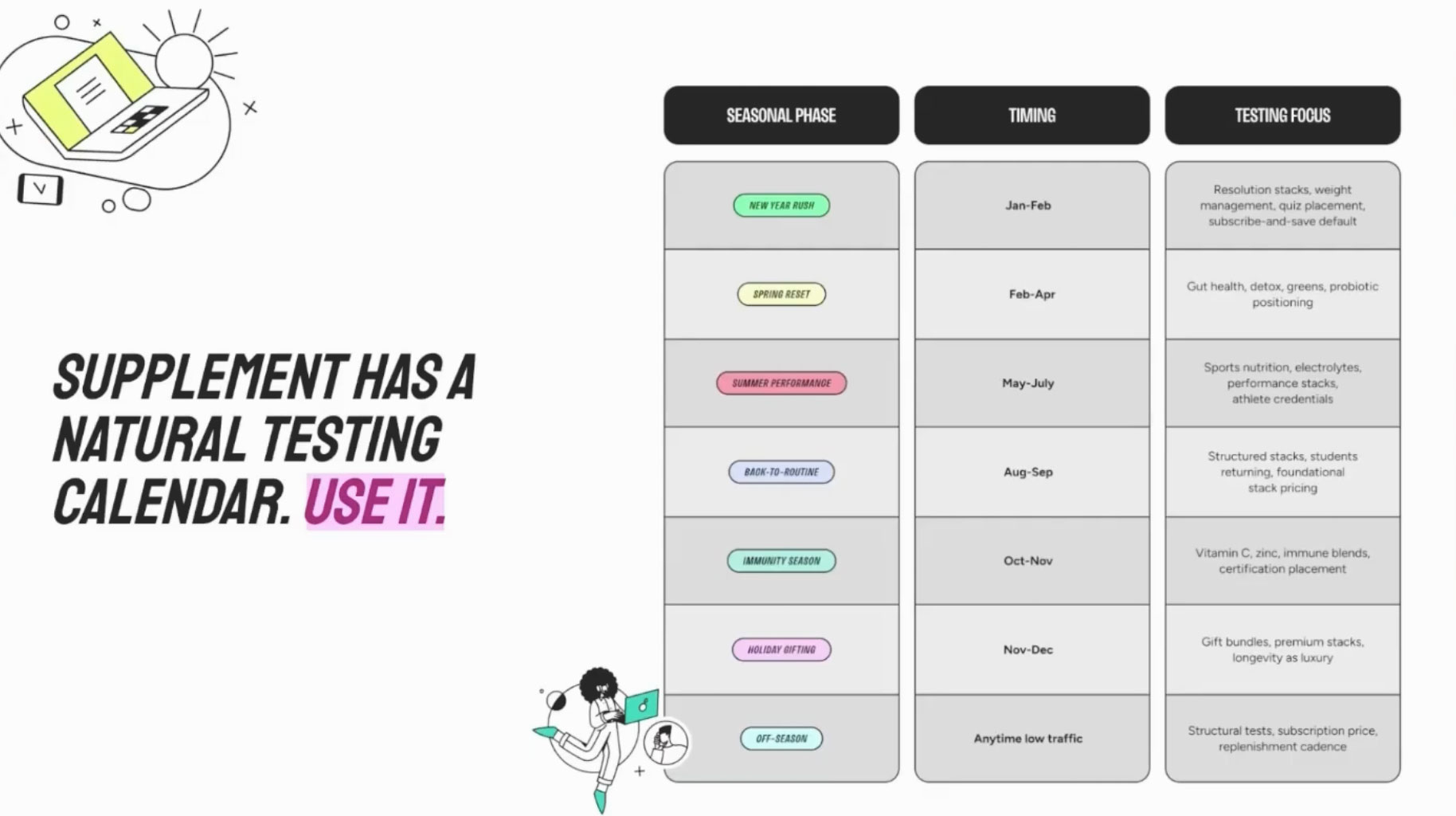
Build a 12-Month Testing Calendar, Not a One-Time CRO Sprint
Many supplement brands treat CRO as something to fix before a launch. That is the wrong model. Supplement demand has a natural seasonal rhythm:
- New Year wellness and fitness
- Spring reset and gut health
- Summer performance and hydration
- Back-to-routine habits
- Immunity season
- Holiday gifting and premium bundles
- Off-season structural testing
The best brands map tests to that calendar. Before a seasonal moment arrives, they have already tested the PDP structure, subscription prompt, bundle logic, landing page, offer framing, and email flow.
That is how CRO compounds.
A brand that tests consistently builds a library of proven learnings: which trust signals work, which stacks convert, which subscription cadence retains, which claims resonate, and which product page modules move RPV.
A brand that only tests during launches learns too late.
A Strong Hypothesis Prevents Weak Testing
Every test should begin with a clear hypothesis.
Use this structure:
We believe that [change] will [outcome] because [reasoning]. We will measure [metric], define success as [threshold], and run the test for [duration] on [segment].
Example:
“We believe moving third-party testing badges next to the add-to-cart button will increase new visitor PDP conversion because first-time shoppers need proof at the decision moment. We will measure PDP conversion, add-to-cart rate, and RPV across mobile paid traffic for four weeks.”
Good testing requires discipline.
Before launching a test:
- Document the baseline
- Define the primary metric
- Set success criteria
- Identify the segment
- Decide the minimum test duration
- Track downstream effects
- Record learnings whether the test wins or loses
A losing test is still valuable if it teaches the team what customers do not care about.
Common Mistakes Supplement Brands Should Avoid
Mistake 1: Removing Too Much Information
Minimalist PDPs can work in other categories. In supplements, stripping away facts, dosage rationale, certifications, reviews, and proof can damage conversion.
The goal is not less information.
The goal is better hierarchy.
Mistake 2: Treating Certifications as Decorative Badges
A certification is not just a logo. It answers a shopper’s trust question.
Explain what it means and place it where purchase hesitation happens.
Mistake 3: Optimizing Only for Conversion Rate
A higher conversion rate with lower AOV, weaker subscription attach, or poor first-renewal retention may not be a win.
Use RPV, attach rate, stack rate, and retention to evaluate the full impact.
Mistake 4: Using Generic Cross-Sells
“You may also like” is not enough.
Supplement recommendations should be routine-aware, goal-aware, and curated.
Mistake 5: Measuring Subscription Tests Too Early
Do not declare a subscription test successful after seven days of attach-rate data.
Wait for first-renewal behavior.
Mistake 6: Ignoring Mobile Trust Placement
Many supplement shoppers evaluate on mobile. If the supplement facts, certification badges, claims, and subscription options are not clear on mobile, the funnel leaks.
The Bottom Line
Supplement CRO is not about running random A/B tests.
It is about building a better buying system.
Trust gets the first order.
Differentiation gives the shopper a reason to choose you.
Stacks increase order value and routine adoption.
Subscriptions turn replenishment into predictable revenue.
Retention proves the customer experience is working.
The brands that win are not simply the ones with better products.
They are the ones that test the customer journey more intelligently.
They know which signals earn trust.
They know which claims convert without overpromising.
They know which products belong together.
They know how to frame subscription value.
They know when to optimize for conversion, AOV, attach rate, or LTV.
That is the real advantage of supplement CRO.
Not a better button color.
A better growth system.
Download the Full Supplement CRO Playbook
This article only covers the strategic framework.
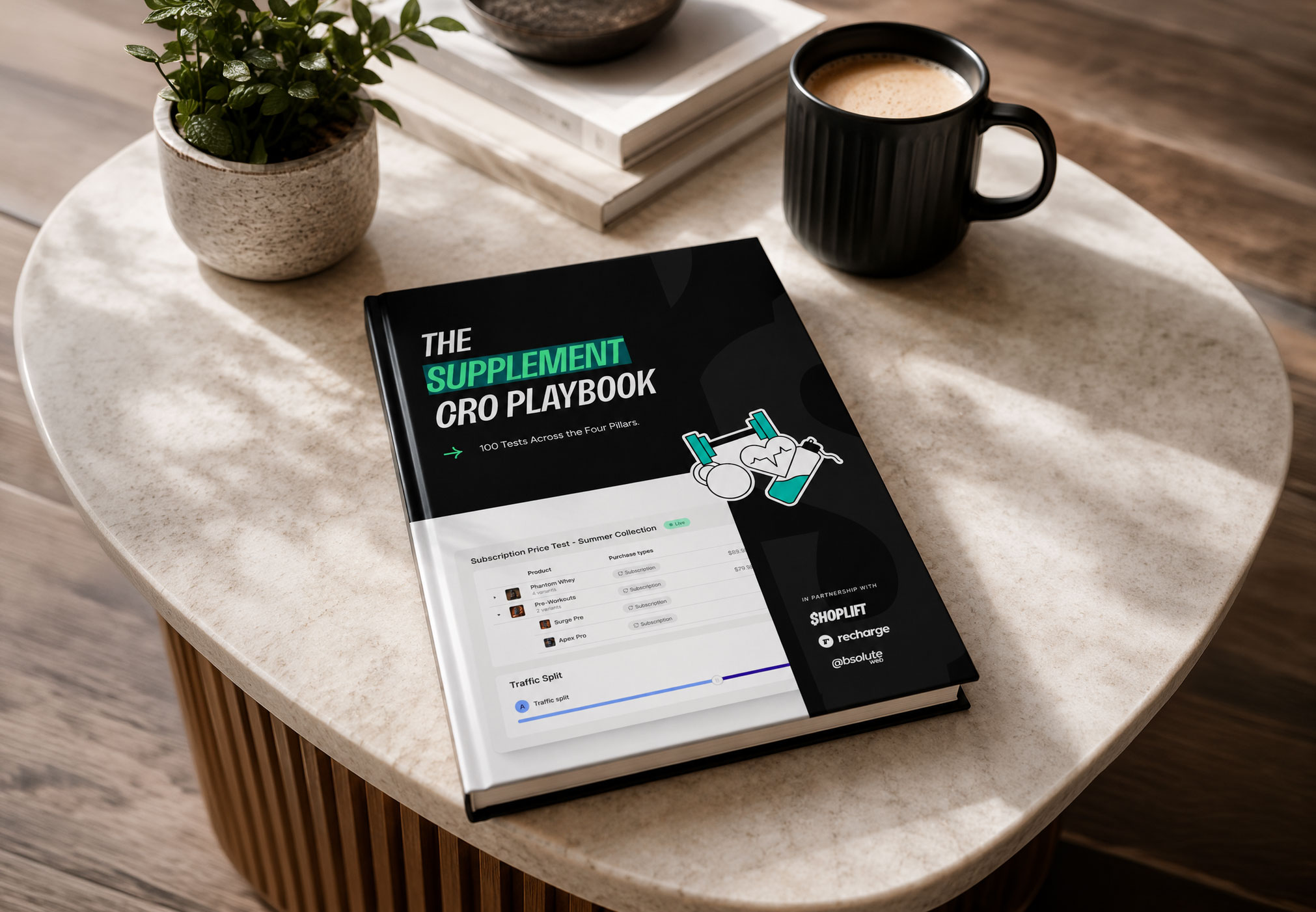
For the complete report, including 100 category-specific CRO test ideas, a 12-month testing roadmap, and the full masterclass from Shoplift, Recharge, and Absolute Web, download the full playbook here:
Download the Supplement CRO Playbook
Ready to Identify Your Highest-Impact Supplement CRO Opportunities?
Absolute Web helps supplement brands uncover and execute the growth opportunities that matter most across CRO, development, UX/UI, subscription optimization, personalization, SEO, retention, and lifecycle strategy.
Whether your goal is to improve conversion rate, increase subscription attach, grow AOV, reduce churn, or build a structured testing roadmap, our team can help identify the highest-impact next steps for your brand.
Run better tests. Build better journeys. Grow with more confidence.
Contact Absolute Web to schedule a supplement ecommerce and CRO audit.

Promoted
EEE Miami 2027 – The Most Inspiring Ecommerce Conference

February 3-5, 2027 | Miami, FL
In-Person Event | Get Tickets

More Articles

DoorDash Launches Native Shopify Integration: What It Means for Local Retailers
DoorDash and Shopify are making it easier for local retailers to meet a growing customer expectation: getti...

Building Trust, Community & Emotional Loyalty in Digital Commerce
At EEE Miami 2026, one of the most refreshing conversations wasn’t about ad hacks, funnels, or scaling spen...

Shopify Spring 2026 Editions: What Ecommerce Brands Should Prioritize Next
Shopify’s Spring 2026 Editions is more than another product release. It is a clear signal of where ecommerc...

Growing LTV from Online Shoppers Through Smarter Customer Insights
At EEE Miami 2026, one theme kept surfacing across conversations, panels, and hallway chats: how do you gro...

The Future of Commerce: Human Creativity in an AI-Driven World
At EEE Miami 2026, one of the most practical and honest conversations around AI in ecommerce didn’t revolve...

Is Your Ecommerce Website Ready for AI Agents? The New Frontier of Ecommerce SEO
For years, ecommerce optimization focused on two audiences: humans and search engines. Today, there is a th...

Building What Matters: The Founder’s Blueprint for Brand Longevity
In today’s ecommerce landscape, building a brand is easier than ever. Building one that lasts? That’s a com...
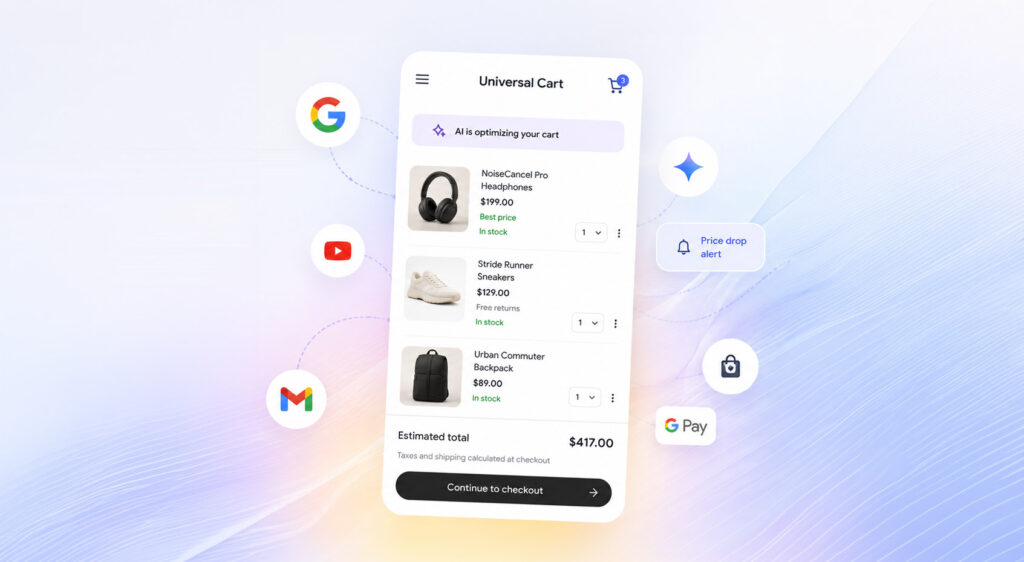
Google’s Universal Cart Could Reshape Ecommerce Faster Than Most Brands Expect
At Google I/O 2026, Google introduced “Universal Cart,” a new AI-powered shopping layer designed to follow ...
Social Feed
