






Top 20 Shopify Winter ’26 Updates Every Ecommerce Brand Should Know
Our strategic take on the most important changes from Shopify’s 150+ feature release
Shopify’s Winter ’26 Edition delivered over 150 updates across AI, B2B, POS, discounts, developer tooling, and platform extensibility. While every update has value, not all of them carry the same weight for brands operating at scale.
As a Shopify Platinum Partner, Absolute Web works closely with growth-stage, mid-market, and enterprise brands that push Shopify beyond “out-of-the-box.” We asked a simple question internally:
Which updates will materially change how brands operate, scale, and compete in 2026?
Below are the Top 20 Shopify Winter ’26 updates we believe every serious brand should understand, prioritize, and in many cases implement now. This list reflects both strategic impact and hands-on technical reality, informed by our delivery teams and insights from Georgiy Slobodenyuk, Director of Technology at Absolute Web.
Listen to our podcast on this topic:
1. Agentic Commerce: Selling Inside AI Conversations
Shopify now enables products to be discovered and purchased directly within AI assistants like ChatGPT and other agent-based interfaces.
Why it matters:
Customer discovery is shifting away from traditional search. Agentic commerce introduces an entirely new funnel where AI acts as the storefront, recommendation engine, and checkout facilitator. Brands that prepare early gain first-mover advantage in a channel that will only expand.
Learn more:
https://www.shopify.com/editions/winter2026
2. Sidekick App Extensions: Custom AI for Your Business
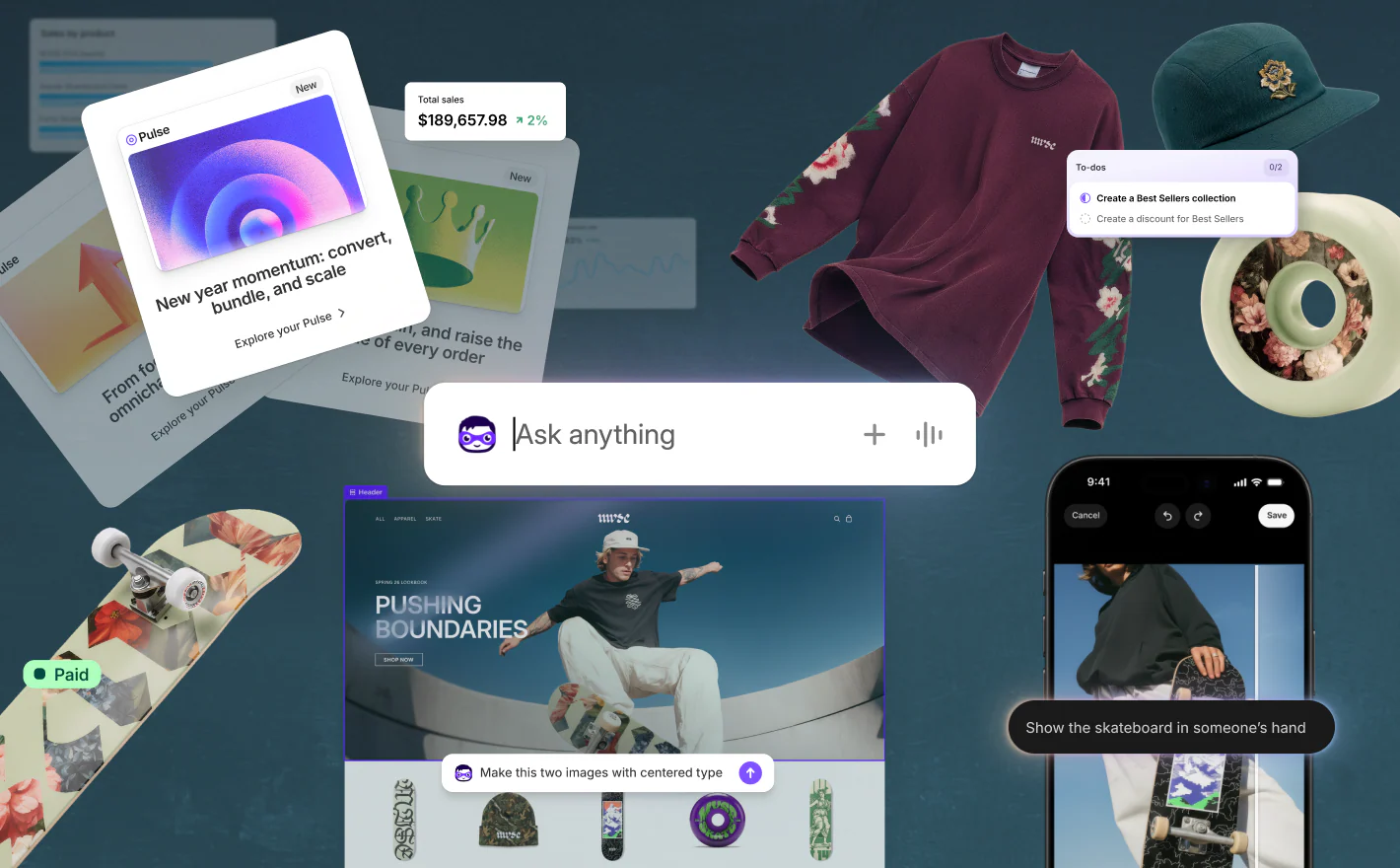
One of the most powerful Winter ’26 updates is Sidekick App Extensions, which allow apps to expose custom data and logic directly to Sidekick. Sidekick can now be extended via apps to surface custom business data and logic directly inside Shopify.
Why this matters:
- Sidekick can answer questions using your ERP, subscription, loyalty, or custom data
- Merchants can get real answers without digging through dashboards
- Sidekick becomes a unified interface for commerce intelligence
This transforms Sidekick from a generic assistant into a custom AI layer tailored to your business.
3. Dedicated ERP Integration Support for B2B Commerce
Shopify now provides a dedicated help desk and framework for ERP integrations, specifically for B2B and complex operational setups.
Why it matters:
ERP-driven brands are no longer treated as edge cases. Shopify is clearly investing in NetSuite, SAP, Dynamics, Brightpearl, and custom ERP architectures. Learn more here.
4. Out-of-the-Box EDI for Retail and Wholesale Brands
With officially supported apps like Crstl and SPS Commerce, Shopify now offers practical, no-code or low-code EDI setups.
Impact:
- Faster retailer onboarding
- Full EDI compliance without custom pipelines
- Lower cost and operational risk
This is a major unlock for brands selling wholesale or operating omnichannel.
Learn more:
https://apps.shopify.com/crstl-b2b-commerce-network
https://apps.shopify.com/sps-commerce
5. Admin Intents API: Seamless Multi-Step App and Theme Setup
The Admin Intents API allows apps and themes to guide merchants through complex setup flows while keeping them inside the app context.
Why it matters:
Cleaner onboarding, fewer errors, and faster time-to-value for custom solutions.
This dramatically improves merchant onboarding, reduces misconfigurations, and makes advanced features feel intuitive instead of overwhelming.
6. Advanced Discount Logic With Discount Rejections (Coming Soon)
Shopify is finally enabling apps to access all discounts entered by a customer and intelligently reject or compare them.
Why this matters:
- Prevent incompatible discount stacking
- Apply the best-value discount automatically
- Enable enterprise-grade promotion logic
This has been a long-standing limitation for sophisticated brands. Learn more:
https://shopify.dev/docs/apps/build/discounts/discount-rejections
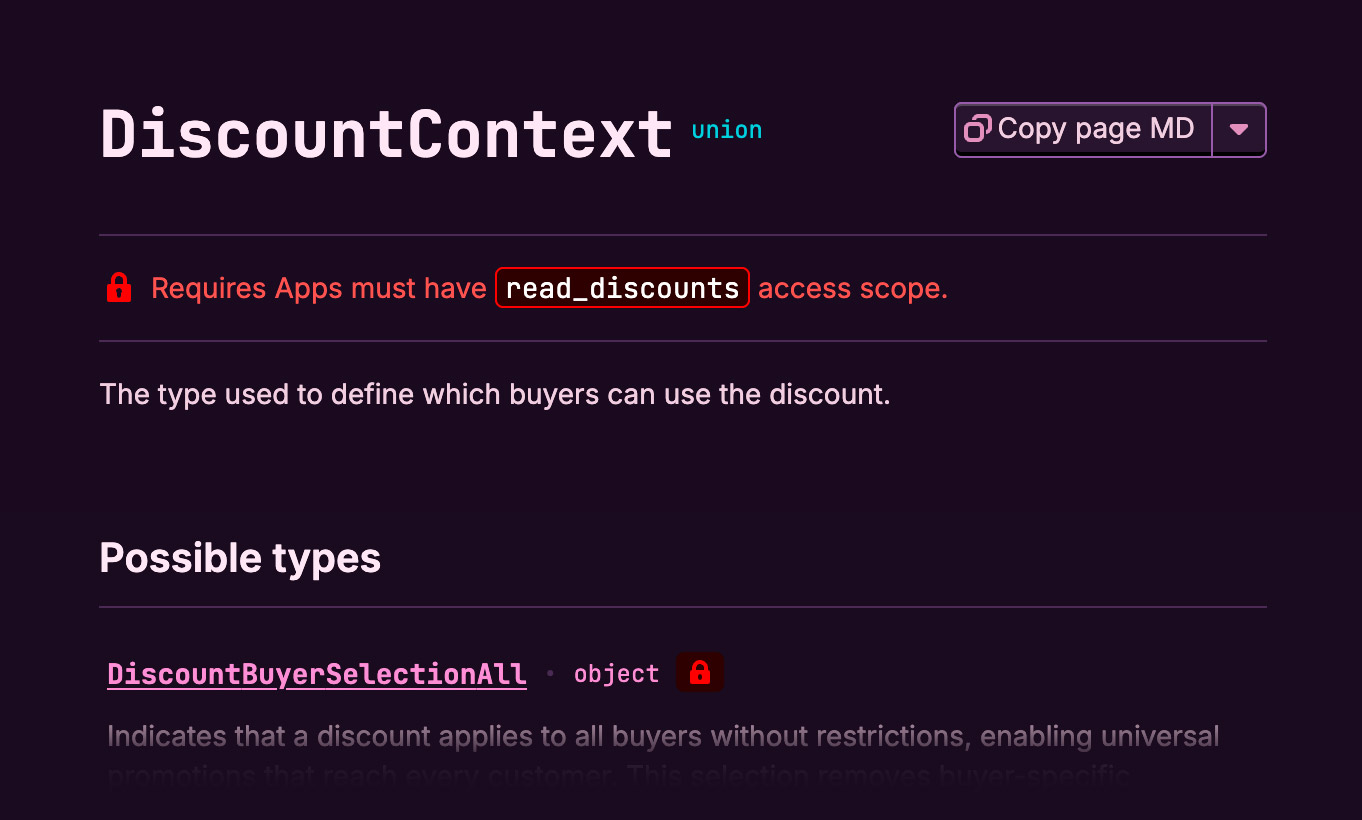
7. DiscountContext: Segment-Based Discounts Without Custom Code
Discounts can now be applied based on Shopify customer segments, rather than hard-coded logic.
Why this is huge:
- Marketing teams can manage discount logic themselves
- No metafield syncs or background jobs
- Loyalty tiers and promotions become fully dynamic
This is a big step toward self-service, enterprise-level discounting. Marketing teams can manage loyalty tiers, spend-based promotions, and segmentation-driven discounts without developer involvement or brittle sync logic.
Learn more:
https://shopify.dev/docs/api/admin-graphql/latest/unions/DiscountContext
8. POS UI Extensions Reach Customization Parity
Shopify POS customization has reached a new level with expanded POS UI Extensions.
Impact:
- Custom cart and line-item logic in POS
- Subscription selling in-store
- Consistent logic across online and retail
Shopify POS is no longer lightweight, it’s now a fully extensible commerce surface. Online and in-store commerce logic can finally align. Shopify POS becomes a fully extensible surface, not a constrained add-on.
Learn more:
https://shopify.dev/docs/api/pos-ui-extensions
https://shopify.dev/changelog/pos-ui-extensions-developer-experience-improvements
9. Native A/B Testing and Scheduled Rollouts
Shopify now supports built-in A/B testing and controlled feature Rollouts.
Why it matters:
Brands can test high-impact changes safely without third-party tools or risky launches. Schedule theme changes and A/B test with Rollouts, built directly into the admin.
Get notified when this becomes available here:
https://www.shopify.com/editions/winter2026#rollouts
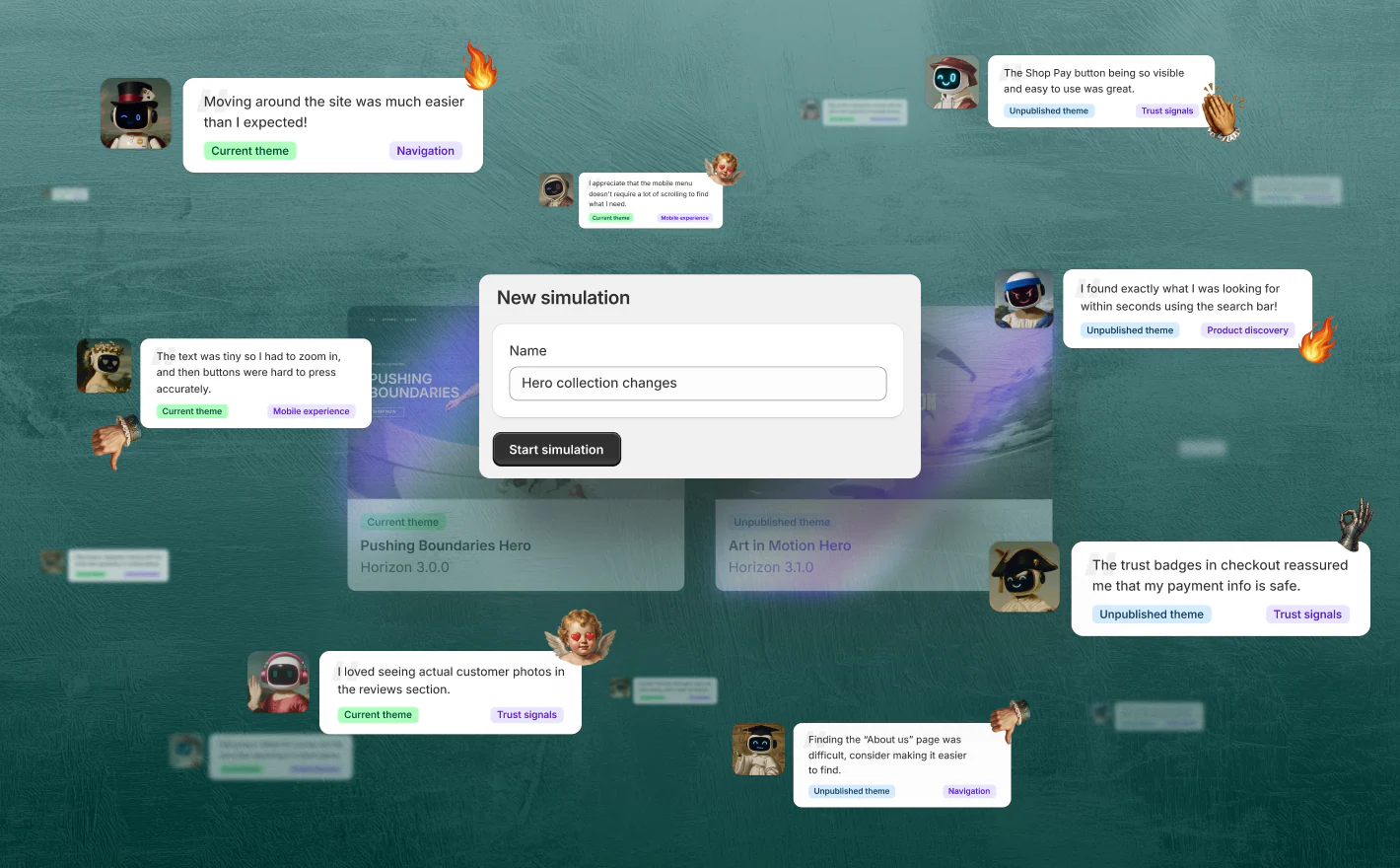
10. SimGym: AI Storefront Simulation
SimGym allows merchants to simulate storefront changes before going live.
Impact:
Lower risk during redesigns and higher confidence in conversion-focused decisions.
11. Product Variants Expanded to 2,048 Per Product
The jump from 100 to 2,048 variants is a long-overdue upgrade and removes a major constraint for complex catalogs.
Best for:
Fashion, configurable products, wholesale, and B2B catalogs.
12. Unlisted Product Status
Products can now be hidden from search and collections while remaining purchasable via direct link.
Use cases:
Private launches, B2B catalogs, influencer drops, and gated offers.
13. Advanced Collection Exclusion Rules
Smart collections now support exclusion logic, not just inclusion.
Why it matters:
Cleaner merchandising without hacks or workarounds.
14. Horizon Theme Performance Improvements
Shopify’s Horizon themes received extensive performance and UX enhancements.

Impact:
Faster load times and better mobile conversion out of the box.
15. AI-Generated Themes During Onboarding
Merchants can generate themes using AI even before completing store setup.
Why it matters:
Faster MVP launches and quicker experimentation.
16. Improved Customer Account and Sign-In Experience
Shopify continues to invest in the customer account experience with faster sign-in, tighter Shop app integration, and more flexibility around account-related content.
Why it matters:
Customer accounts are no longer just a utility. They are becoming a core engagement surface. Faster authentication and smoother account access reduce friction after purchase and make it easier for brands to drive repeat behavior, subscriptions, loyalty usage, and B2B reordering.
For brands running subscriptions, loyalty programs, or repeat-heavy catalogs, improvements here directly impact retention and lifetime value. When paired with custom account experiences, this also opens the door to more personalized post-purchase journeys.
Learn more:
https://changelog.shopify.com
17. Checkout Optimization and Extensibility Improvements
Shopify continues to refine checkout extensibility, performance, and stability across all plans, building on the foundation introduced with Checkout Extensibility.
Why it matters:
Checkout is where revenue is won or lost. Even marginal improvements in speed, clarity, or logic compound significantly at scale. These updates give brands more confidence to customize checkout logic, integrate third-party services, and introduce advanced use cases like conditional messaging, dynamic discounts, or payment logic, without sacrificing performance or upgrade safety.
For enterprise brands, this reinforces Shopify’s checkout as both high-converting and safely extensible, something that historically required trade-offs.
18. AI-Assisted Inventory Insights and Forecasting
hopify is making inventory intelligence more accessible by surfacing AI-assisted insights directly inside the platform.
Why it matters:
Inventory mismanagement is one of the most common growth bottlenecks for scaling brands. Overstock ties up cash, while stockouts kill momentum and customer trust. These new insights help merchants identify risk earlier and make more informed replenishment decisions without relying solely on external tools.
For brands operating across multiple warehouses, sales channels, or regions, this is another step toward Shopify becoming a true operational command center, not just a sales platform.
Learn more:
https://www.shopify.com/editions/winter2026
19. Developer AI Workflows for Faster Builds
Shopify’s developer platform is increasingly AI-native, with tools that understand commerce context and accelerate development workflows.
Why it matters:
Custom development is still essential for differentiated brands, but speed and reliability matter more than ever. AI-aware tooling helps teams build, test, and iterate faster while reducing errors and maintenance overhead.
From a brand perspective, this translates into:
- shorter implementation timelines
- lower long-term development costs
- faster experimentation with new features
It also means agencies and internal teams can spend more time on strategy and less on repetitive scaffolding work.
Learn more:
https://www.shopify.com/news/winter-26-edition-dev
20. Native Marketing and Social Content Generation
Shopify now supports generating marketing and social content directly within the platform using AI-powered tools.
Why it matters:
Speed to market is a competitive advantage. For lean teams, generating first-draft content directly in Shopify reduces friction between merchandising, marketing, and execution. While this doesn’t replace a strong brand voice or creative strategy, it dramatically accelerates campaign launches and experimentation.
Used correctly, these tools become an efficiency layer, allowing teams to focus more on optimization and less on starting from a blank page.
Our Final Take: Shopify Is Building for Complex, Scaled Commerce
Winter ’26 makes one thing clear: Shopify is no longer just optimizing for ease of launch. It’s building a platform capable of supporting:
- ERP-first architectures.
- EDI-driven retail and wholesale.
- Complex discounting and loyalty logic.
- Deeply customized POS and admin workflows.
- AI-powered decision-making across the stack.
At Absolute Web, this aligns perfectly with where our clients are heading.
If your brand wants help prioritizing or implementing these updates, especially around B2B, ERP, EDI, discounts, POS, or Sidekick extensions, our team is already working hands-on with these capabilities.
Reach out to Absolute Web to make sure you’re not just aware of Shopify Winter ’26, but actually taking advantage of it.


More Articles
Amazon Is Rewriting Delivery Expectations. Again. Ecommerce ...
Amazon just raised the bar again. With the rollout of…
Read more

ChatGPT 5.4 and “Thinking Mode”: What Ecommerce ...
OpenAI recently introduced GPT-5.4, the latest upgrade powering ChatGPT and…
Read more
Shopify Deprecates Legacy Customer Accounts. Here’s What ...
Shopify has officially marked Legacy Customer Accounts as deprecated. This…
Read more

How Strategic CRO Helped Nulastin Increase Subscriber ...
Subscription brands don’t win by chasing one-time conversions. They win…
Read more

EEE Miami 2026: The Conference That’s Redefining ...
If you’ve been in ecommerce long enough, you know most…
Read more

How Subscription Data Is Powering the Next ...
Ecommerce UX has traditionally been built around a single moment:…
Read more

ChatGPT Shopping Research: What It Means for ...
OpenAI just released ChatGPT Shopping Research, and it’s quietly becoming…
Read more

The Best Ecommerce Conferences and Marketing Events ...
Your guide to the most impactful, innovative, and ROI-positive events…
Read more
Social Feed
